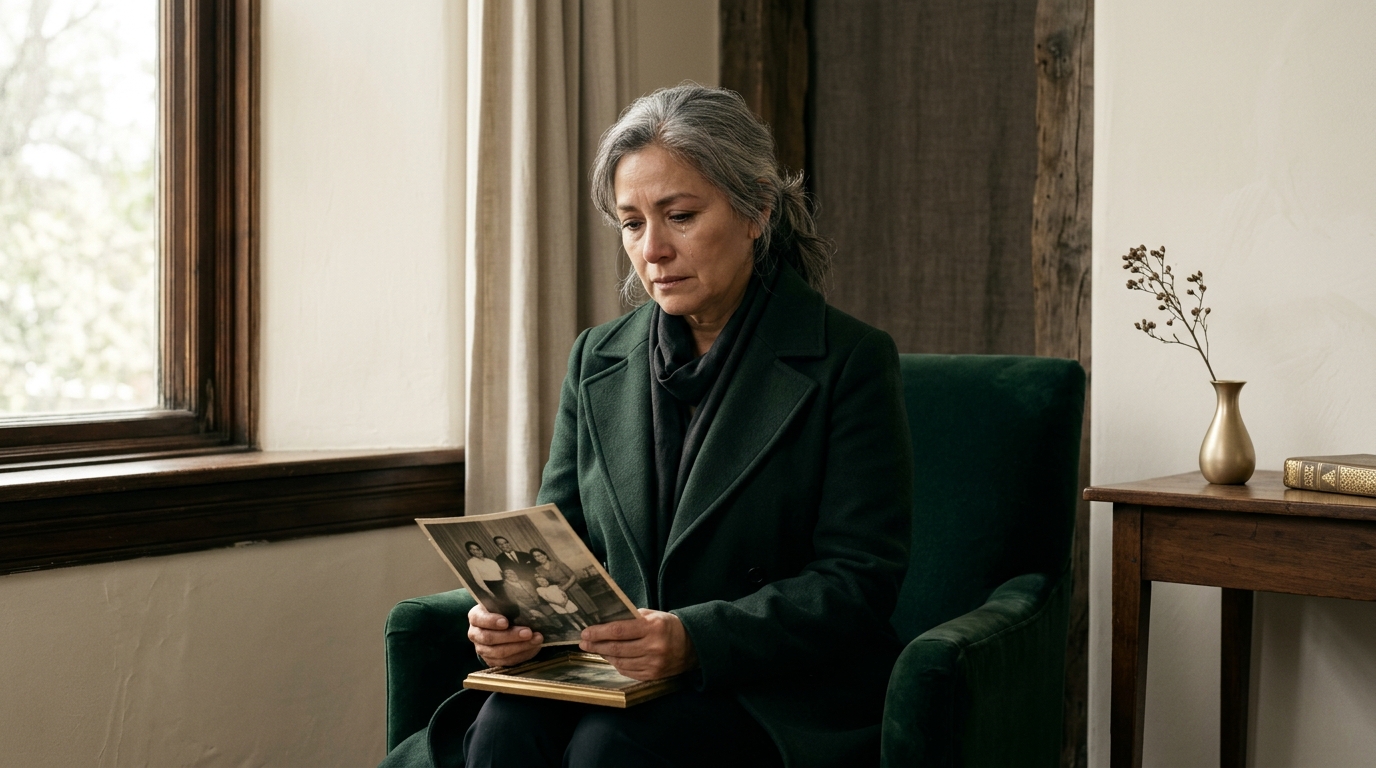
- The cultural script for parental loss is minimized — "it's the natural order" — which leaves adult children ashamed of grief that exceeds the permission they were given.
- You become orphaned regardless of your age. Being no longer anyone's child is a loss with no good name in English.
- The relationship is now exactly what it was at the moment of death; unresolved conversations become permanent. Writing the conversation anyway is the only form of resolution available.
- Month two is when the real grief arrives — exactly when the world has decided you should be okay.
- The family reorganizes around the absence, the childhood home is its own second grief, and year two may be harder than year one.
It is a Tuesday morning, and you reach for your phone to call your mother before you remember. Or it is Sunday, and the weekly call does not happen. Or someone asks how you are doing, six weeks after the funeral, and you realize you no longer know how to answer the question.
The death itself was not, in the end, the worst of it. The death was the event the world acknowledged. The grief is what arrives quietly afterward, in moments the world has already moved past.
Most of what is written about losing a parent treats it as a finite event — a death, a funeral, a period of bereavement, then the resumption of life. That framing is incomplete in a way that leaves readers feeling alone with experiences that are, in fact, almost universal. Here is what the existing scripts mostly miss.
The grief does not honor the script that says it shouldn't be this big
The cultural script for parental loss is brief: parents die. It is the natural order. You are an adult now. You have already had decades with them. You will grieve and you will heal.
The script is not wrong, exactly. It is just not the whole picture.
The grief that arrives after a parent's death frequently exceeds what the script makes room for. You expected a measured, time-limited bereavement and find yourself, at month four or month eight, ambushed by something you cannot quite locate. You feel, in some unspoken way, that you are doing the grief wrong — that you should be done with it, that the people around you have finished checking in, that the version of you on display in public is supposed to be functional.
You are also exhausted. You cannot sleep through the night. You have lost your capacity for small talk. You do not enjoy the things you used to enjoy.
There is no script for this. The script for spousal loss is rigid; the script for parental loss is minimized. Both are inadequate. The version of you that is grieving a parent is doing the work the script does not show, in the part of life the script does not make room for.
You become orphaned, regardless of your age
The word orphan is not used for adults. It should be.
When the second parent dies — or when the only parent you had a relationship with dies — something happens that has no good name in English. You are no longer anyone's child. The generation that came before you is gone. You are, suddenly and without warning, in the front row.
This is true at 35, at 50, at 70. It does not get less true with age. It changes shape. Younger orphans grieve the years they will not have. Older orphans grieve the version of themselves that was always, until this moment, somebody's daughter.
There is a specific quiet that lives inside this. Friends do not have it. A spouse cannot share it. A sibling has their own version of it, but not yours. It is the only quiet you cannot, in the end, fill in with anything else.
The relationship is now exactly what it was
The conversations you did not have are now conversations you will not have. The questions you did not ask are now permanent questions. The version of the relationship that existed at the moment of death is the version that exists forever.
This is harder than it sounds.
If the relationship was complicated — and most parent-child relationships are, in some way — death does not resolve the complication. It freezes it. There is no more chance to repair the misunderstanding, to ask the question that was always too hard, to hear the apology, to give one. You were waiting for the right moment, and the right moment has passed without notice.
This is not a failure on your part. It is the nature of the situation. The grief includes the conversations that will never happen, and there is no version of doing this work that retrieves them.
What can be done, sometimes — and this is the part the script truly does not name — is to write the conversation anyway. Out loud, on paper, in the quiet of an early morning. The parent will not hear it. You will. That is, in the end, the only version of resolution available, and many readers find it does more than they expected.
The world stops asking quickly
You will be checked on, with intensity, for about three weeks. Casseroles will arrive. Texts will arrive. Then the texts will taper, and the casseroles will stop, and the people around you will return to their own lives, which is the appropriate thing for them to do.
The problem is that month two is when the real grief arrives.
The death itself produces shock. The funeral produces structure. The first weeks produce a kind of survival momentum. By month two, the structure is gone, the momentum is gone, the shock has worn off, and you are inside the actual experience of the loss for the first time.
This is also the moment the world has decided you should be okay.
The mismatch is not anyone's fault. It is the predictable shape of a culture that does not understand grief well. But it is real, and naming it removes some of the shame that often arrives at month three, when you notice you are more affected now than you were at the funeral and conclude that something must be wrong with you.
There is nothing wrong with you. The world is on a different schedule.
The family reorganizes around the absence
The parent who has died was performing roles in the family system that you may not have realized were happening until the parent stopped performing them. The mother who held the holidays. The father who organized the calls. The parent who remembered the birthdays, the parent who held the family stories, the parent who was the connective tissue between siblings.
When that parent goes, the connective tissue goes. The family does not necessarily fall apart, but it has to be rebuilt. Decisions that used to flow through the parent now have to be made between the surviving siblings, who may not have spoken to each other this directly in decades. The family stories that used to be told at holidays are now untold or told differently. The version of the family you grew up in does not exist anymore.
This is one of the more underdiscussed losses inside the loss. It is also one of the more durable ones. The reorganization takes years, sometimes longer. It is not finished at the one-year mark, or the three-year mark. The family that emerges is a new family, and the work of figuring out what it looks like is ongoing for as long as the surviving siblings are alive.
The childhood home is its own grief
If there is a house — the house you grew up in, or the house your parents lived in for the last decades — the eventual sale or emptying of that house is its own bereavement, separate from the death of the parent.
The dishes in the cupboard. The chair your father sat in. The smell of your mother's kitchen. The closet where the photographs were kept. These are not just objects. They are the physical scaffolding of childhood, and the dispersing of them is the ending of a place that existed in your memory and does not exist anywhere else now.
People who have done this work consistently report being unprepared for the depth of the second grief. The first grief was for the parent. The second grief is for the place — and behind the place, the version of yourself that lived there, who is also, in some sense, no longer reachable.
There is no faster way through this. There is just the version where you do it with someone, or alone, and the version where you give yourself permission to feel what is true while you are doing it.
You will hear them for years
The voice of a parent — its rhythms, its specific phrases, its judgments and encouragements — is one of the deepest internal voices you carry. After the death, the voice does not leave. You will hear your mother saying the things she would have said. You will hear your father's small comment about the weather, or the news, or the meal you are eating.
This is not a sign of unresolved grief. It is the way memory works. The voice will, in some form, stay with you for the rest of your life. You will lose pieces of it — the exact tone, the specific phrasing — and the loss of those pieces is its own small grief inside the larger one.
What is also true: the voice often becomes kinder over time. The judgments you struggled with while the parent was alive may soften in your memory; the encouragements may become more available than they were in life. This is not revisionism. It is, often, what was always true underneath, finally audible because the relationship is no longer being negotiated in real time.
Year two may be harder than year one
The pattern that surfaces in widowhood and in gray divorce surfaces here too. Year one, you are held by the work of the funeral, the estate, the early grief, the people checking in. Year two, the work has ended and the people have moved on, and the actual integration of the loss into your life begins.
If you find yourself, eighteen months in, more affected than you were at six months — you are not failing. You are doing the part of the work the first year did not have room for. The lift, when it comes, is not a single moment. It is the slow accumulation of a life that includes the loss as a fact, rather than working around it as a wound.
What stays
You are no longer anyone's child. That is the loss the cultural script does not name. It is also the place from which the next part of your life is built — not in spite of the loss but because of it, in a quieter and more deliberate way than the script suggests is possible.
The grief does not end. It changes shape. The relationship continues, in the form available to you now, in the voice you carry, in the holidays you still mark, in the way you find yourself, in some small way, becoming them.
If you are inside this now, you are not behind. You are doing this at the only pace it can be done.
Frequently Asked Questions
Why does losing a parent hurt more than I expected?
The cultural script says parents die, it is the natural order, and you will grieve and heal. The script is not wrong, but it is not the whole picture. The grief that arrives after a parent's death frequently exceeds what the script makes room for, and the mismatch leaves people feeling they are doing the grief wrong. They are not. The script for parental loss is minimized, and it is inadequate.
Why is month two after a parent's death so hard?
You are checked on intensely for about three weeks. Then the texts taper, the casseroles stop, and people return to their own lives. The funeral produced structure and the first weeks produced survival momentum; by month two those are gone, the shock has worn off, and you are inside the actual experience of the loss for the first time — at the moment the world has decided you should be okay. There is nothing wrong with you. The world is on a different schedule.
What can I do about the conversations I never had with my parent?
Death does not resolve a complicated relationship; it freezes it. The conversations not had are now conversations that will not happen. What can sometimes be done is to write the conversation anyway — out loud, on paper, in the quiet of an early morning. The parent will not hear it; you will. Many people find it does more than they expected.
Why is selling my parents' house so painful?
The eventual sale or emptying of a childhood home is its own bereavement, separate from the death. The dishes, the chair, the smell of the kitchen are the physical scaffolding of childhood, and dispersing them ends a place that now exists only in memory. People consistently report being unprepared for the depth of this second grief.
References & Notes
- George Bonanno, The Other Side of Sadness (2009); Mary-Frances O'Connor, The Grieving Brain (2022); J. William Worden, Grief Counseling and Grief Therapy — bereavement research consistent with the patterns described here (month-two onset of grief, year-two intensification, family reorganization, and the persistence of a parent's voice).