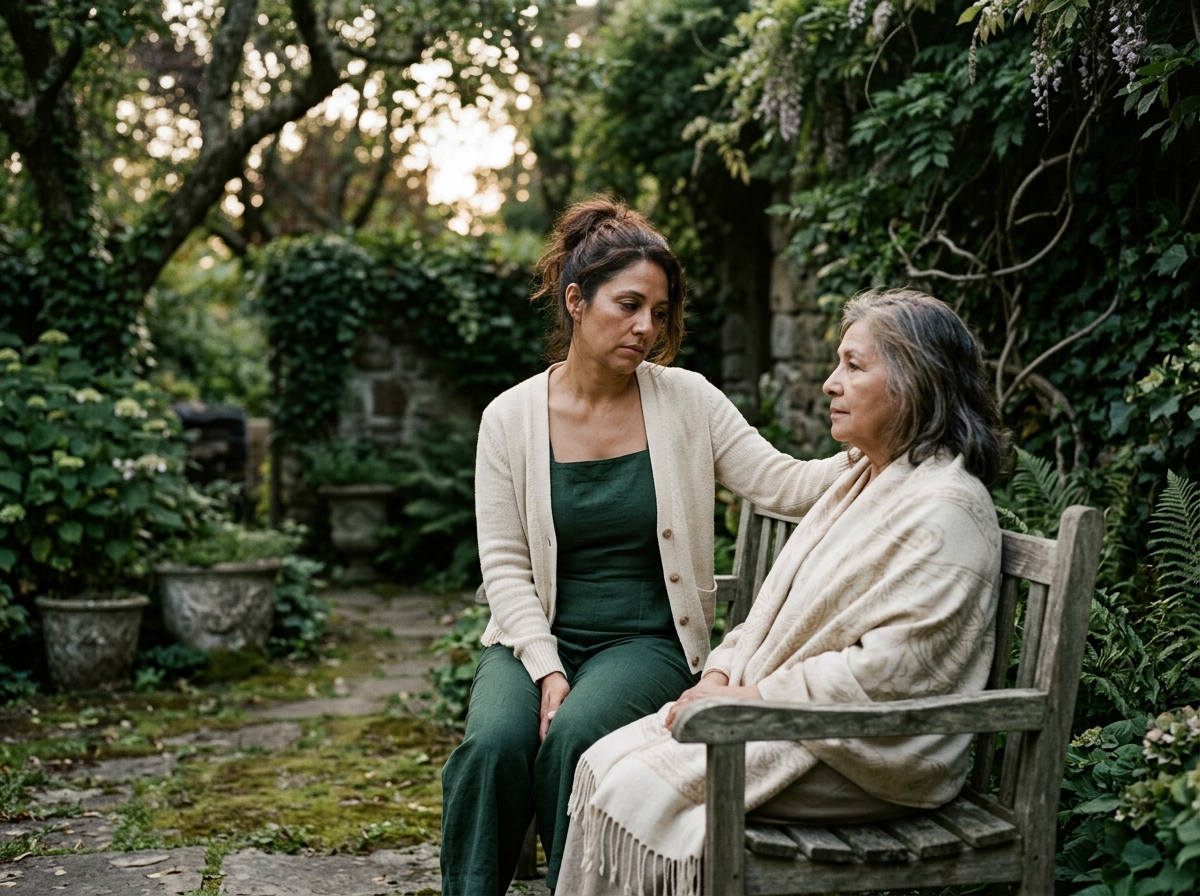
- The diagnosis is the easier part. What it does first is rewrite the past; what it does next is start a grief that begins years before the death.
- There is a name for it — ambiguous loss, the grief for someone physically here and psychologically going — and no ritual for it. No candle, no casserole.
- The arithmetic compounds in two directions: a four-to-eight-year arc that Medicare does not cover, and your own lost earnings, promotions and retirement contributions — a wealth transfer in reverse.
- Somewhere in the middle the relationship inverts. Capacity is not a switch but a dial, moving one way, and the loneliest decisions are the ones you used to make together.
- What survives is not the version of her you most want to keep. It is flickers, small objects, and the person you become — the friend who knows to say almost nothing, and mean it.
The diagnosis
The diagnosis arrives on a Tuesday afternoon. A neurologist you have met twice tells you what you already suspected, in language a little softer than you expected, with a folder of materials you won't read for three weeks. Your mother is sitting next to you wearing the green cardigan she bought in Wilton in 2003. You drive home from the appointment together. She comments on a billboard. She doesn't bring up the diagnosis. Neither do you.
It will take months to realize that the diagnosis itself was the easier part.
What the diagnosis does first is rewrite the past. You begin to see the missed checks, the repeated questions you wrote off as her being tired, the afternoon she called you twice and you found it sweet. You run a reel of memory in your head and look for the moment the slow thing began. There is no such moment. There never was. You will run the reel anyway.
The word dementia sits in your mouth differently than any other diagnosis you have had to carry. Cancer at least promises a fight with stages and treatments and a recognizable shape. Heart disease gives you a number to lower and a procedure to schedule. Dementia gives you neither. What it gives you is a clock that started running before you knew it was running, and a person who is, in some literal way, already leaving.
You will tell people in the weeks after, gently, that your mother has been diagnosed. They will say "I'm so sorry." Then most of them will ask, with real concern, how she is doing. You will not have an answer that does not require either a lie or a paragraph.
Ambiguous loss
There is a name for what you are feeling, but no one will offer it to you in the early years. A psychologist named Pauline Boss spent her career studying it. She called it ambiguous loss — the grief of someone who is physically here and psychologically gone, or the reverse. Dementia is the textbook case. The body in front of you is your mother. The mind in front of you is increasingly not.
This is what no one tells you. The grief starts before the death. Sometimes years before. You are mourning someone who is sitting at your kitchen table asking the same question for the fourth time in an hour. You are mourning the version of her who taught you to drive, who hosted Thanksgiving, who knew where the spare key was. You cannot post about it. You cannot light a candle. You cannot accept a casserole. There is no ritual for the loss of a person who is still alive, and so the loss has nowhere to go.
What it does instead is settle in your body. You become the person at the dinner party who can't quite track the conversation. You snap at your spouse. You can't tell whether you are depressed or just tired in a way that doesn't lift.
The friends you expected to lean on will surprise you in both directions. Some will rise to it in ways you didn't anticipate — sending text messages with no expectation of reply, dropping off food without asking permission, listening without trying to fix. Others will retreat, sometimes the closest ones. People do not know how to be present for a grief that has no obvious milestone, and some of them will stop trying. You will lose friendships you cared about. You will also discover new ones, often unexpected ones, with the small group of people who have walked the same road.
The ones who walked it themselves will know to say almost nothing.
The arithmetic
No one prepares you for the arithmetic.
The average dementia diagnosis precedes death by four to eight years. Sometimes a decade. In that time, the person you are caring for will require an escalating amount of supervision, and at some point — though the timeline is unknowable — full-time care. Memory care facilities in most American metros cost well into six figures annually. In-home care, calculated honestly, often costs more. Medicare does not cover it. Long-term care insurance covers some of it, if your parent was disciplined enough to buy a good policy in their fifties, which most weren't.
The arithmetic that compounds is the one no one teaches you to calculate: your own. The hours per week you give up. The promotion you don't pursue. The years you delay your own retirement saving to fund hers. Your children watching you become a person who is always a little far away.
If you are working while caregiving, you are also losing roughly three hundred thousand dollars in lifetime earnings on average — a number that is well-documented and almost never discussed at the family meeting. The cost of caring for a parent with dementia is, in addition to everything else, a wealth transfer in reverse: from the generation that should be building toward its own longevity to the generation that is leaving.
You will be told, often by people who mean well, that you should not feel guilty about resenting any of this. The resentment will arrive anyway. So will the love. They will coexist in ways you will not have language for until much later.
The inversion
Somewhere in the middle, the relationship inverts.
You become the parent. Not metaphorically — operationally. You manage her medications. You schedule her appointments. You take the car keys. You sign forms she used to sign. At some point — the most painful point, often — the question of capacity arises in a legal sense. Can she still make her own medical decisions? Her own financial ones? The doctor will offer a soft assessment. A lawyer will ask for a harder one. You will discover that capacity is not a switch but a dial, and the dial is moving in one direction only.
What no one prepares you for is the loneliness of decisions you used to make together with someone, and now make for them. The choice to take the keys away. The choice to move her out of the house she has lived in for forty years. The choice — if it ever comes to this — about whether to treat the pneumonia aggressively. You will make these decisions late at night, looking at her photograph, asking yourself what she would want. The answer is never as clear as you thought it would be when she still could have told you.
There will be a version of your mother you encounter at three in the afternoon who knows you, who asks about your children, who is recognizably herself in flickers. There will be another version at three in the morning who does not know what house she is in and who is afraid of you. You will love both. You will not always know what to do with either.
The siblings will not always help. Some will help in ways that don't feel like help. Some will arrive only on holidays and tell you you're being too cautious, or not cautious enough, or that you've changed. Some of them will be right. The disagreements about who Mom really is now, and what she really wants, will strain marriages and reorder family relationships in ways you did not see coming when this started.
The hardest conversations you will have in this period will not be with your parent. They will be with the people who knew her before.
What survives
The thing that survives is not the version of her you most want to keep.
The flickers stay longest in unexpected places. A piece of music she taught you to play at nine. The way she said your name when you walked into a room. The phrasing of a particular Thanksgiving toast. You will recognize her, sometimes, in a stranger's gesture for the rest of your life.
You will find yourself, years later, holding onto small things you didn't know you were holding. A recipe in her handwriting. A voicemail you almost deleted. A sweater that still carries her perfume in the threads. The mind that left you slowly leaves a different kind of map behind.
What survives in you is harder to see while it is forming. You will become, in the slowest possible way, someone who has done one of the harder things and lived through it. Not without cost — the cost is real and ongoing. Not without resentment — the resentment was earned. Not gracefully — there is no graceful way to do this. But you will have done it. Years from now, when someone you love is at the beginning of this, you will be the friend who knows to say almost nothing, and to mean it.
That, for what it is worth, is the inheritance.
Frequently Asked Questions
What is ambiguous loss in dementia caregiving?
A term from psychologist Pauline Boss for the grief of someone who is physically present but psychologically going, or the reverse. Dementia is the textbook case: the body at the kitchen table is your mother; the mind increasingly is not. The grief starts before the death, and because there is no ritual for it, it settles in the caregiver's body instead.
How long does dementia last after diagnosis?
On average four to eight years, sometimes a decade or more. Over that time the person will need escalating supervision and at some point full-time care. Memory care runs well into six figures a year in most American metros, Medicare does not cover it, and long-term care insurance covers some of it only if a good policy was bought decades earlier.
What is the hardest part of caring for a parent with dementia?
Many caregivers say the hardest conversations are not with the parent but with the people who knew her before — siblings who arrive on holidays and disagree about who she really is now and what she wants — and the loneliness of decisions you used to make together: the keys, the house, whether to treat the pneumonia.
Is it normal to resent caring for a parent with dementia?
Yes. The resentment arrives regardless of how much you love the person, and the two coexist in ways there is no language for until later. It is also normal to lose friendships along the way, and to find new ones among the small group of people who have walked the same road.
References & Notes
- Pauline Boss — the concept of ambiguous loss (Ambiguous Loss: Learning to Live with Unresolved Grief, Harvard University Press).
- Alzheimer's Association, Alzheimer's Disease Facts and Figures — average four to eight years from diagnosis to death.
- Lifetime earnings cost of roughly $300,000 for working caregivers — see The caregiver penalty no one warned you about.